


JONATHAN MEESE
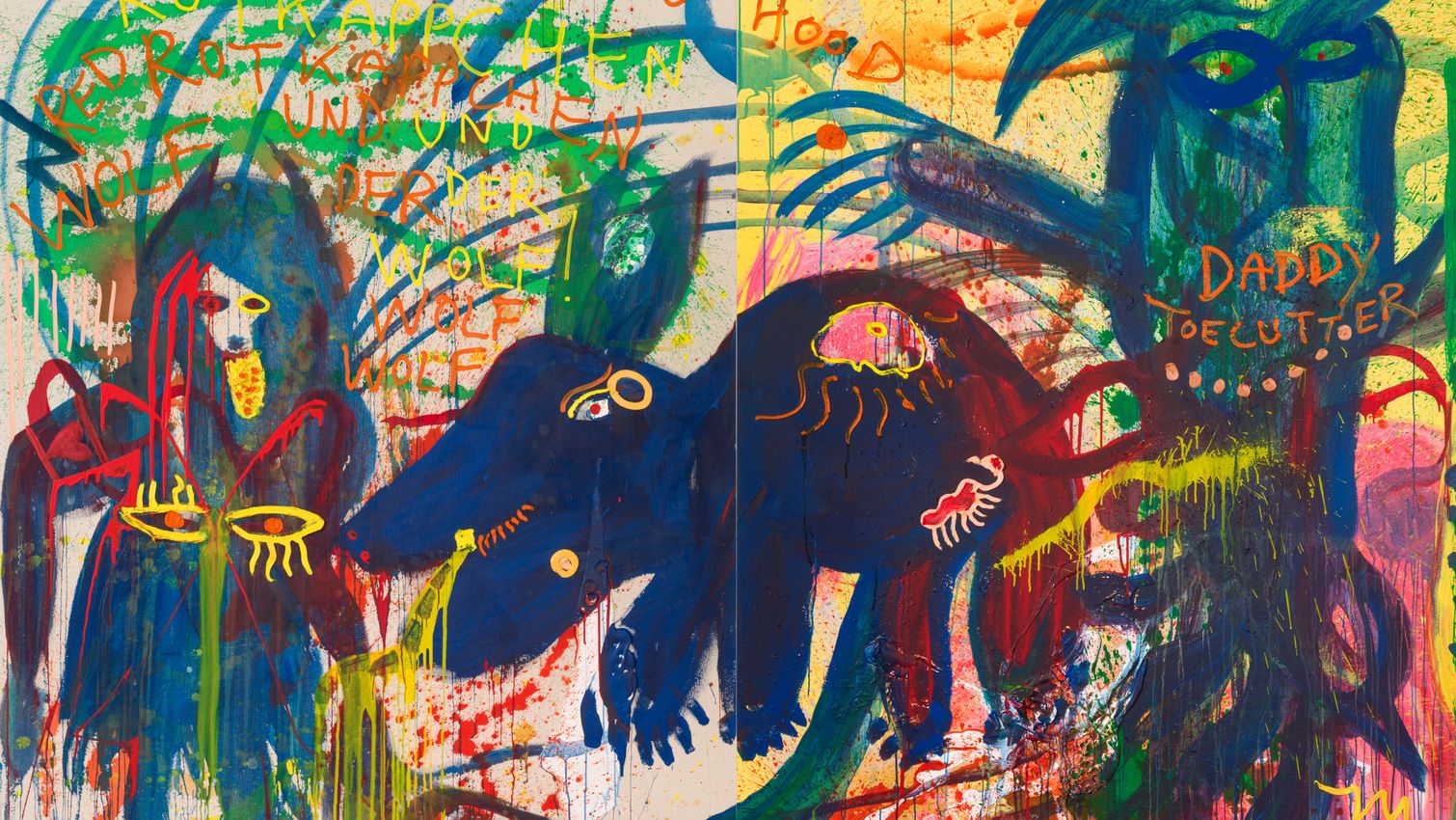
b. 1970, JapanIn his artistic practice, Jonathan Meese has often walked a fine line between provocation and controversy. His Neo-expressionist-inspired work spans performance, painting, installations and sculpture and espouses “the dictatorship of art”.
Early Years
Jonathan Meese was born in Tokyo in 1970 but moved back to Germany with his mother later in the decade. As a teenager he invented his own language, comprising grimaces and made-up words. On his 22nd birthday he was out in Hamburg with his mother, Brigitte, who asked him what he would like as a gift. He asked for art supplies and immediately began drawing and painting. Within a year he was studying at Hochschule der Künste in Hamburg, where one of his professors was the performance artist Franz Erhard Walther.
Jonathan Meese: Artworks
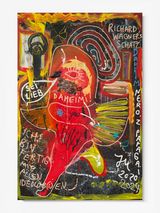
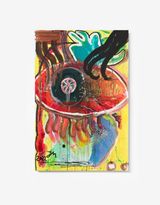
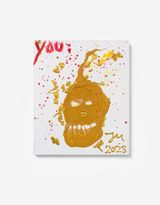
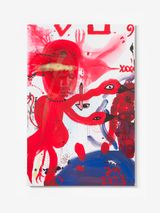
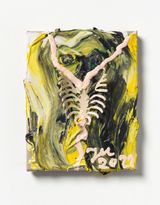
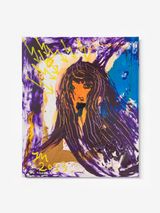
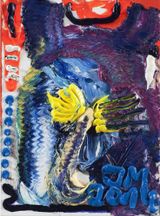
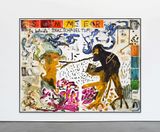
Jonathan Meese’s art-making spans painting, performance, sculpture, assemblage, drawing, stage design, choreography and costume. He addresses ideas of history, politics and cultural memory, exploring the idea that without culture, society fails to exist. He takes inspiration from books and films, and uses found objects alongside photography and graffiti-like manifestos. His drawing-and-painting practice uses crayon, acrylic, ink, watercolour and graphite, creating surface and texture (sometimes by applying paint straight from the tube). His work denounces political and religious ideology and controversially sometimes includes German military symbols (although his artworks empty them of meaning).
- In Stanley Kubrick de Large (1—4), a 2002 collaboration with Albert Ohlen, Meese painted the director as a head of propaganda in a black, white and brown abstraction characterised by smears of colour.
- BUBBEL DE BABE, PULL PULLI-PULL-PULLSNS’ VOLLE PULLE (2014—2015) is a huge three-panel piece featuring strawberries, the model Cara Delevingne, graffiti and streaks of paint.
- In 2021, Meese imagined “the first animal” in the acrylic-and-pencil piece _Baby de_Babe_: a cat-like form with brown and yellow fir and bright green eyes.
Jonathan Meese: Select Exhibitions
Select Solo Exhibitions
- P.O.P.² (POWERPLAY — OVERKILL — PING|PONG/(DR. NO’S MOTHER(Z))/(THEY LIVE), Tim Van Laere Gallery, Antwerp (2026)
- Dracula’s Liebe Mutterz: B se Leiche?!?, Wasserkirche Zurich (2024)
- ACROSS THE UNIVERSE (DR SPACE-ANIMALISM “E.A.G.L.E.”: FLY LIKE AN EAGLE), David Nolan Gallery, New York City (2021)
- Jonathan Meese, Galerie Krinzinger, Vienna (2017)
- Tropical Alaska-Kid (Der Molokobefehl), Regina Gallery, Moscow (2013)
- Mishima is back, Tomio Koyama Gallery, Tokyo (2009)
- DON’T CALL US, WE CALL YOU, Galerie Krinzinger, Vienna (2007)
- Das Bildnis des Dr Fu Manchu, Contemporary Fine Arts, Berlin (2004)
- Jonathan Meese, Leo Koenig, New York City (2001)
- Schnitt bringt Schnitte, Ausstellungsraum Schnitt, Cologne (1999)
- Jonathan Meese, Kunstverein Kehdingen, Freiburg (1997)
Select Group Exhibitions
- Visual Voices, Galleri Bo Bjerggaard, Copenhagen (2025)
- Conversations, Museum Mayer van den Bergh, Antwerp (2023)
- In aller Munde—Von Pieter Bruegel bis Cindy Sherman, Kunstmuseum Wolfsburg (2020)
- Theories of Modern Art, Stuart Shave/Modern Art, London (2016)
- Things Beyond Our Control, Frederic Snitzer Gallery, Miami (2012)
- Le Brouillard de Dr Ceramique, Jean Claude Binoche, Paris (2009)
- Mythos. Matrix des Weltbildes, Upstairs Berlin (2007)
- deutschemalereizweitausendrei, Frankfurter Kunstverein (2003)
- Musterkarte, Galería Heinrich Ehrhardt, Madrid (2001)
- Site Construction, South London Gallery, London (1998)
Further Reading
Jonathan Meese FAQs
What was Jonathan Meese’s relationship with his mother?
Meese had an extremely strong bond with his mother Brigitte. Speaking in 2011 he described her as “total authority, naturally” and she was a focal point in both his life and his artistic practice. She would join him in his studio, for example, advising when he should stop painting. Meese’s mother was a key element of his early-2026 exhibition at the Tim Van Laere Gallery in Antwerp; however, she was reported to have died in April of that year.
What was Jonathan Meese’s Nazi salute controversy?
In 2012, as part of an event at the University of Kassel called Megalomania in the Art World, Meese was accused of making the banned Nazi salute twice and went to trial in 2013. During the court case, Meese wore entirely black. He was acquitted (the defence was that the gestures were part of a performance) and said after the verdict: “Art has triumphed.”
Has Jonathan Meese made a techno album?
Yes, he has made two, teaming up with DJ Hell as Meese x Hell. They produced Hab keine Angst, hab keine Angst, ich bin deine Angst in 2021 and Gesamtklärwerk Deutschland in 2025.
Ocula

View Jonathan Meese's Artworks

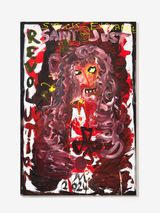

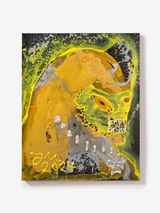


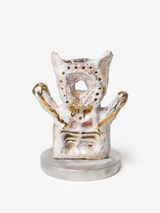











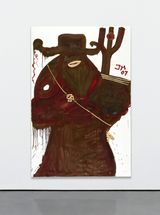
Explore Jonathan Meese's Exhibitions

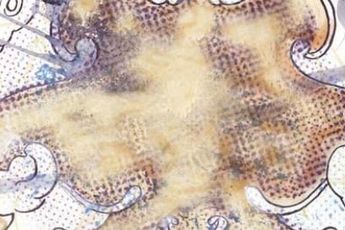

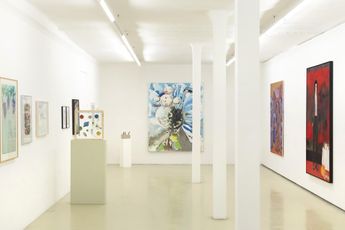

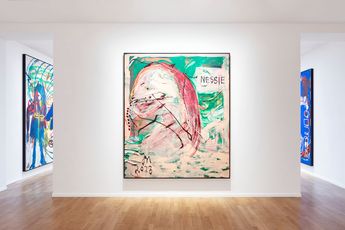




Explore and Follow Artists Shaping Contemporary Art
A respected voice in contemporary art discourse.
Focusing on ambitious storytelling and insightful art-world commentary. Ocula Magazine publishes in-depth interviews, critical essays and timely analysis on the artists, exhibitions and ideas driving the global art world.
Learn more about Ocula Magazine
Showcasing the best of the art world.
Ocula partners with galleries from around the world to highlight their artists, artworks and exhibitions. Gallery membership is by application and invitation, with each member vetted by an independent panel.
Learn more about Ocula Membership
Specialises in the sale of major artworks.
Led by a team with deep ties to the world’s leading auction houses, galleries and collectors. Ocula’s advisory team offers bespoke services to high-net-worth clients from around the world who are looking to acquire the best of contemporary and modern art.
Learn more about our team and services